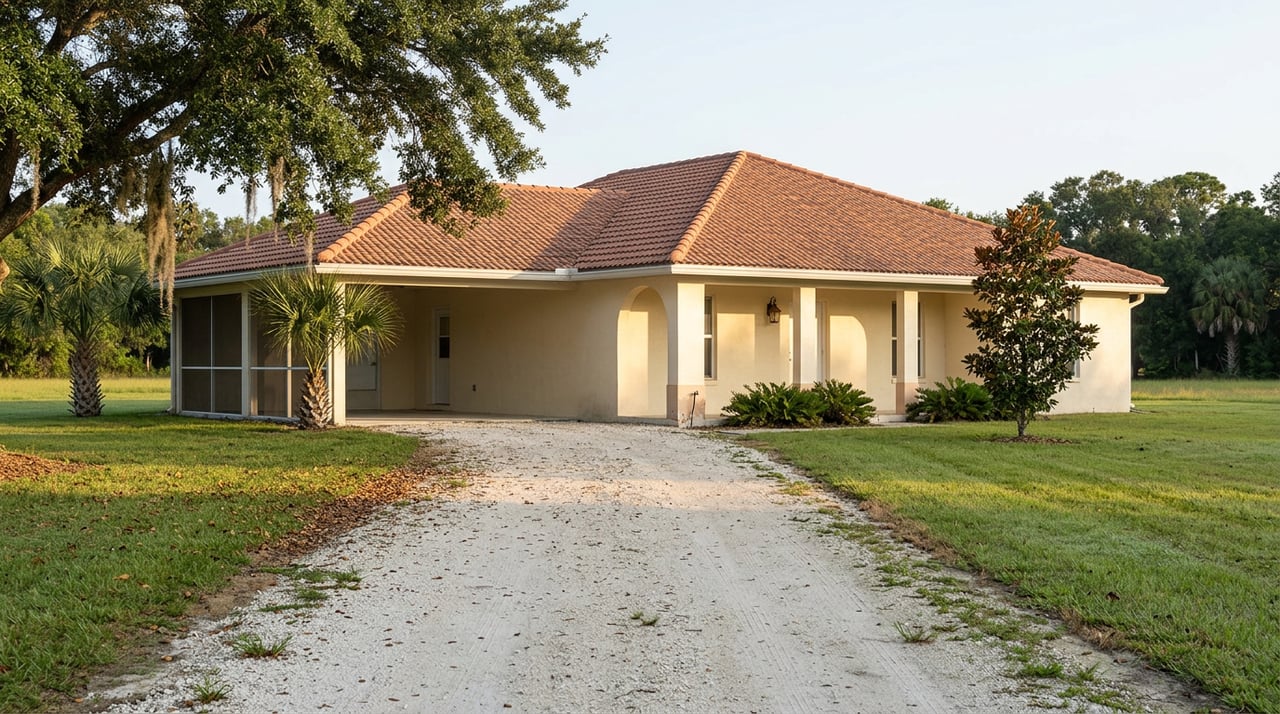
Loxahatchee Acreage Prices vs Wellington: What to Know
August 20, 2026
August 20, 2026
An equestrian buyer comparing acreage in Wellington and Loxahatchee this month will run into a number that looks almost too good to check twice. Wellington's equestrian core is trading somewhere north of $800,000 an acre. A comparable horse property a short drive west, some parcels advertise being under fifteen minutes from the show grounds, can run under $170,000 an acre. On paper, that reads like the same lifestyle at a fifth of the cost.
It isn't the same asset. The gap is real, but so is what the gap is paying for on one side and shifting onto the buyer on the other.
Atlantic Western's most recent Wellington Land Report put equestrian land sales for the twelve months ending September 2025 at an average of roughly $844,000 per acre, up from about $692,000 an acre just three years earlier. Inside the most competitive submarkets, the numbers get sharper still. In Wellington's Southfields section, home to the National Polo Center and Global Dressage, the lone major transaction during the survey period closed at $3.8 million an acre, and remaining listings there were asking around $3,000,000 an acre.
Compare that to Loxahatchee Groves, where equestrian properties currently on the market average about $169,710 an acre. Depending on which Wellington submarket you're measuring against, that's a gap of five times to nearly twenty times.
A buyer who has priced land only in Wellington and then sees a Loxahatchee farm at a fraction of the cost is doing real math. What they're often missing is that Wellington's per-acre number already has a set of costs baked in that a Loxahatchee number does not: paved roads, engineered drainage, a homeowners association or municipal body maintaining shared infrastructure, and a scarcity premium tied to a footprint that Wellington's own broker community describes as effectively built out. Loxahatchee's lower number reflects the absence of some of that infrastructure, not simply a less fashionable zip code.
| Typical price per acre | Who maintains roads and drainage | |
|---|---|---|
| Wellington equestrian core | roughly $800,000 to $3,000,000+ | Village-managed and HOA-managed systems in most gated communities |
| Loxahatchee / The Acreage | roughly $170,000 average | Indian Trail Improvement District (per-acre assessment) |
| Loxahatchee Groves | roughly $170,000 average | Loxahatchee Groves Water Control District |
Most of unincorporated Loxahatchee, the area locals call the Acreage, sits inside the Indian Trail Improvement District. ITID isn't an HOA. It's a special taxing district created by the Florida Legislature that maintains roads, canals, and parks across roughly 27,000 acres and about 50,000 residents, including more than 250 miles of dirt road and 164 miles of canal. That maintenance is funded through a uniform per-acre assessment that shows up separately from your county property tax bill.
For fiscal year 2026, most ITID property owners are paying $1,065 per acre. The district's board is finishing its fiscal year 2027 budget this week. At a June 2026 workshop, staff proposed decreases for most of the district's 21 taxing units, some substantial, Unit 10 could see a per-acre drop of $170.36, while six units would see increases, the largest being $28.37 per acre in Unit 14. The board's final vote on that budget is scheduled for August 19, two days from now.
That per-acre assessment is the piece a Wellington-to-Loxahatchee price comparison tends to leave out. It doesn't disqualify the discount. It does mean the true annual carrying cost of Loxahatchee acreage includes a recurring line item that Wellington buyers, paying into HOA dues or municipal infrastructure through their much higher purchase price, experience differently.
Buyers researching "Loxahatchee" often don't realize they're actually comparing two different jurisdictions with two different infrastructure arrangements. The incorporated Town of Loxahatchee Groves runs its own government, and its roads and canals fall under the Loxahatchee Groves Water Control District, a separate body covering roughly 8,000 acres with about 29 miles of unpaved roads and 30 miles of canals. The broader unincorporated area to the north, commonly called the Acreage, follows Palm Beach County rules and answers to ITID instead.
Two properties five miles apart, both marketed as "Loxahatchee," can carry different assessment structures, different road maintenance responsibility, and different permitting authority depending on which side of that line they sit on. Confirming which government applies to a specific parcel is a due diligence step, not a formality.
That two-track system traces back to how the land was originally platted. As one local real estate professional put it:
"The Acreage in Loxahatchee was laid out in one-acre or larger parcels by design. The original development plan in the 1960s and 70s intentionally spaced lots to allow horses, chickens, and agricultural uses alongside residential ones."
That intent is still visible on the ground today, in the wide lots, the working barns next to modest homes, and the acreage that makes Loxahatchee attractive to buyers priced out of Wellington's equestrian preserve.
Beyond the assessment, the infrastructure gap between the two markets shows up in a handful of ownership responsibilities that a Wellington buyer, especially one moving from a paved, HOA-managed farm, may not have priced in:
None of this makes Loxahatchee acreage a worse purchase. It makes the discount a transfer of responsibility from a managing body to the individual owner, which is a different kind of ownership than a five-acre farm inside a Wellington HOA with paved private roads and engineered drainage already in place.
Loxahatchee's market has some slack in it right now. Recent snapshot data put the median time on market at 104 days, with roughly 8.3 months of supply, a level generally read as favoring buyers over sellers. That gives a buyer real room to ask for what a Wellington transaction might not require: a fresh well test, a septic inspection instead of a pump receipt, verification of which water district or improvement district governs the parcel, and clarity on whether the current owner has ever needed emergency well repairs during a storm.
A buyer who treats the Loxahatchee discount as free money is pricing land. A buyer who treats it as a cost transfer, and negotiates accordingly, is pricing the property they're actually about to own.
Does the ITID assessment show up before closing? It should appear on the seller's property tax bill as a separate non-ad valorem assessment, and a title search or closing disclosure will typically reflect it. Confirming the current per-acre rate for the specific taxing unit, since the district's 21 units are not all assessed the same, is worth doing before you write an offer, not after.
Is Loxahatchee Groves under the same water authority as the Acreage? No. The incorporated Town of Loxahatchee Groves has its own Water Control District covering its roads and canals, separate from the Indian Trail Improvement District that serves the unincorporated Acreage to the north. A parcel's address alone won't tell you which one applies.
Does a lower price per acre in Loxahatchee mean lower total ownership cost than Wellington? Not automatically. It typically means a different distribution of cost, less concentrated in the purchase price and more spread across an annual assessment, well and septic upkeep, and road conditions that a Wellington HOA or municipal system would otherwise absorb.
Comparing a Loxahatchee farm to a Wellington farm on price per acre alone will always favor Loxahatchee. Comparing what each dollar is actually buying, in infrastructure, in governance, and in what you'll be responsible for maintaining yourself, is the conversation worth having before you write an offer on either. Martha's Properties works both sides of that line every season and can walk you through which assessment, which water district, and which due diligence applies to the specific parcel you're considering. Request private listing access and a consultation to start that conversation.
Stay up to date on the latest real estate trends.


Whether working with buyers or sellers, Martha provides outstanding professionalism into making her client’s real estate dreams a reality. Contact her today for a free consultation for buying, selling, renting, or investing in Florida.
Get in Touch With Martha Team to Learn More

MARTHA W. JOLICOEUR PA
✉ EMAIL:
✆ TELEPHONE NUMBER:
⚲ ADDRESS: 13501 SOUTH SHORE BLVD STE 102 WELLINGTON FL 33414