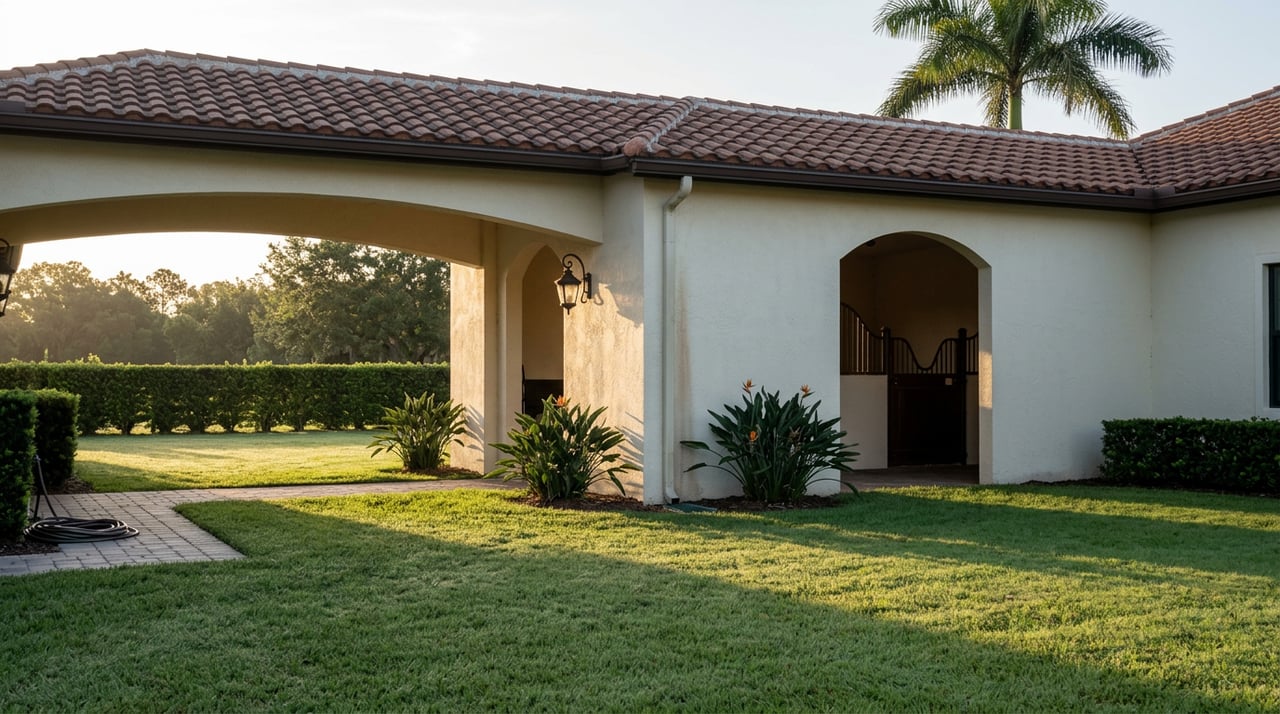
The Wellington Zip Code Covers Two Governments. Only One of Them Owns the Trail Behind Your Barn.
September 17, 2026
September 17, 2026
Two farms list this month, both addressed Wellington, FL 33449. Both have center-aisle barns, both are a short trailer pull from the show grounds, both are priced in the same range. One of them sits inside the Village of Wellington and answers to a zoning code written specifically to protect horse farms. The other sits in unincorporated Palm Beach County, pays no Village tax, often carries no HOA, and answers to a completely different rulebook. A buyer comparing the two on price per acre alone is comparing the wrong thing.
This distinction rarely shows up in a listing description, and it should. It determines whether the bridle trail behind your barn is a protected, capital-funded piece of Village infrastructure or an informal path that exists because a neighbor has tolerated it for twenty years.
Wellington incorporated as a village on December 31, 1995, after a vote that passed by 138 ballots. That close margin matters because it means the current boundary was drawn by a specific political choice, not by geography or by what people colloquially call "Wellington." Everything inside that line falls under Village land development regulations. Everything outside it, even a half mile away with the same mailing address, does not.
Inside the boundary, the Village created the Equestrian Overlay Zoning District in the early 2000s to govern its roughly 9,000-acre Equestrian Preserve Area, the zone that contains the show grounds, the polo fields, and most of the farms people picture when they hear "Wellington." The EOZD framework sets development standards written around horses specifically: stall counts, manure bin requirements, arena siting, and, critically, bridle trail easements that the Village can require as a condition of a development order. Since 1999, the Village has built and maintained more than 100 miles of public and private bridle trails, funded through its capital improvement plan and expanded through an ongoing Equestrian Trails Master Plan.
That trail mileage is not a marketing figure. It is a line item in a municipal budget, reviewed and funded by a Village Council that residents inside the boundary vote for. It is also why a Village-inspired zoning designation can require a landowner to dedicate a bridle path easement as a condition of building a barn, something a county code has no equivalent mechanism to compel.
Step outside the Village line and the same zip code still applies, but none of the above does. Palm Beach County zoning, not the EOZD, governs setbacks, permitted uses, and waste management. There is no Village millage on the tax bill. Many of these county pockets have no HOA at all, which some sellers market directly, advertising a farm as free of both municipal tax and association oversight while still carrying the Wellington name and the 33449 code that buyers associate with proximity to the show grounds.
The Village's own mapping office admits this split plainly. Its geographic information system notes that it maintains active parcel data only within Village limits, and directs anyone researching a property outside that boundary to Palm Beach County's GIS instead. In other words, even the Village cannot tell you what applies to a farm a few hundred yards past its own line. That confirmation has to come from the county.
This is not a story about one side being better. A county-side farm can be a legitimate, well-built property with real savings on the tax bill and none of the HOA architectural review that some Village-adjacent subdivisions impose. A Village-side farm carries a municipal tax obligation and, depending on its subarea, may face EOZD-specific limits on commercial boarding or lot coverage. The point is that the trade is real, it is asymmetric, and it does not show up in a property's street address.
The clearest way to see the trade is side by side.
| Inside Village of Wellington (EOZD/EPA) | Unincorporated Palm Beach County pocket | |
|---|---|---|
| Governing code | Village Land Development Regulations, EOZD standards | Palm Beach County zoning code |
| Municipal tax | Village millage applies | No Village millage |
| Bridle trail access | Village-maintained network, easements can be required by development order | Informal or private access only, no Village dedication mechanism |
| HOA exposure | Varies by subdivision, several Village communities have HOAs | Often none, some listings market this directly |
| Preserve protections | Subject to Equestrian Preserve Area comprehensive plan policies | Not covered by EPA policy |
A buyer weighing these rows against price per acre is doing the real comparison. A buyer weighing price per acre alone against a competing farm two zip-code-adjacent parcels away is comparing two different products that happen to share a mailing label.
The Equestrian Preserve boundary has not been a static line. In 2016, Wellington voters approved a referendum specifically to protect the Preserve from future reductions. That protection was tested a few years later: a proposal to remove roughly 96 acres from the Preserve to make way for residential development at what's known as Wellington North drew more than 8,000 signatures in opposition before the Village Council voted 4-1 in November 2023 to approve the removal, tied to a developer commitment to invest in expanded show grounds elsewhere in the Village. That fight illustrates something buyers should sit with: even land inside the Preserve is not permanently guaranteed to stay there. Land outside the Village boundary was never inside that protection to begin with. It was never something to lose, because it was never something the Preserve covered.
That asymmetry cuts against the assumption that a county-side farm is simply a cheaper version of a Village-side one. It is a structurally different asset with no comprehensive plan language protecting its rural character, no EOZD standards shaping what a neighbor can build next door, and no formal mechanism requiring trail dedication as the area around it develops.
A few checks resolve the ambiguity before it becomes a closing-day surprise.
Does a 33449 zip code mean a property is inside the Village of Wellington? No. The zip code covers both incorporated Village land and unincorporated Palm Beach County pockets nearby. Zip code boundaries and municipal boundaries are drawn independently and do not align.
Can a farm outside Village limits still get bridle trail access? Sometimes, through informal use or private arrangement with neighbors, but not through the formal easement mechanism the Village can require inside the EOZD. There is no guarantee that access continues if neighboring land changes hands or is developed.
Is a Village-side farm always more expensive than a county-side one? Not necessarily on a price-per-acre basis, but a Village-side farm carries a municipal tax obligation that a county-side farm does not. The full cost comparison has to include that recurring line item, not just the purchase price.
Finding the right side of that boundary, and understanding exactly what it means for a specific farm, is the kind of question worth asking before an offer goes in rather than after. Martha's Properties works inside Wellington's equestrian market every day and can walk you through a property's actual jurisdiction, its EOZD standing, and what that means for your plans. Request Private Listing Access & Consultation to start that conversation.
Stay up to date on the latest real estate trends.


Whether working with buyers or sellers, Martha provides outstanding professionalism into making her client’s real estate dreams a reality. Contact her today for a free consultation for buying, selling, renting, or investing in Florida.
Get in Touch With Martha Team to Learn More

MARTHA W. JOLICOEUR PA
✉ EMAIL:
✆ TELEPHONE NUMBER:
⚲ ADDRESS: 13501 SOUTH SHORE BLVD STE 102 WELLINGTON FL 33414