Buying a Wellington Equestrian Farm: Due Diligence Checklist
May 14, 2026
May 14, 2026
Buying a Wellington equestrian farm can feel exciting right up until the details start stacking up. A beautiful barn, a good ring, and a prestigious address are only part of the picture when you are purchasing in a market where zoning, drainage, access, and equine functionality all matter. The right due diligence helps you confirm that the property fits your riding goals, your horse count, and your long-term plans before you close. Let’s dive in.
Your first step is to confirm which rules apply to the property. In Wellington, the Equestrian Preserve Area, or EPA, is the Village’s designated equestrian land-use area, and the Equestrian Overlay Zoning District regulates development there. The EPA covers about 9,000 acres in western and southern Wellington and includes major equestrian venues, bridle trails, and horse farms.
If the parcel sits outside the Village, Palm Beach County rules may control use approvals instead. That matters because the County says the Use Matrix is only a starting point, and supplementary standards must still be reviewed. In some cases, the actual approval required may be more intensive than the matrix alone suggests.
Before you make an offer, request written zoning confirmation for the parcel. You want to know whether your intended use is permitted as-is, allowed with conditions, or likely to require additional approvals. This is especially important if you plan to board horses, train, host events, or add staff housing.
Not every equestrian property supports every equestrian use. In Palm Beach County, a commercial stable is defined as a facility for boarding, breeding, training, or raising horses, and baseline standards include a minimum 5-acre lot, 100 feet of frontage, and 25-foot setbacks.
Private stables have their own thresholds. On a parcel with a single-family residence, a private stable with 12 stalls or fewer is treated as an accessory structure, while more than 12 stalls makes it a principal structure. That distinction can affect setbacks, layout, and future expansion plans.
If you intend to board a few horses for others on a private property, the details still matter. On sites of at least 2 acres, a private stable may board up to 4 horses not owned by the owner or occupant. If your business plan or seasonal needs go beyond that, confirm the approval path before closing.
If you plan to host clinics, shows, or spectator events, review those standards early. County rules for commercial equestrian arenas include paved-street frontage, outdoor activity hours from 5:00 a.m. to 10:00 p.m., loudspeaker limits from 8:00 a.m. to 8:00 p.m., and a requirement that riding and viewing areas and show rings sit at least 100 feet from property lines.
If you want employees or grooms to live on site, ask for documentation on Groom’s Quarters approvals. In Palm Beach County, those approvals are tied to the number of quarters and the stall count. You should also ask whether any recorded conditions affect occupancy or future modifications.
In Wellington, drainage is not a side issue. It is one of the most important parts of farm due diligence, especially in the EPA, where the Village’s Equestrian Preserve Committee specifically advises on flooding and drainage.
Start by checking the property’s flood designation. Wellington directs buyers to Palm Beach County GIS for property-level flood designations, while FEMA’s Flood Map Service Center is the official source for flood hazard information. If the parcel is in a Special Flood Hazard Area, floodplain rules and mandatory flood insurance purchase requirements may apply.
Request the FEMA flood map, any available elevation certificate, and any documents that show how the site handles stormwater. If the property has wetlands, drainage features, or recent site work, ask whether Environmental Resource Permit documentation exists. The South Florida Water Management District requires an Environmental Resource Permit for many development and construction activities, including site grading, stormwater containment and treatment, flood protection facilities, and some work affecting wetlands or surface waters.
A farm can look dry on a sunny day and still have major drainage problems. During your inspection period, walk the paddocks, swales, arena edges, and turnout gates after irrigation or rainfall if possible. Pay special attention to low spots where water may stand or flow across the property.
In Wellington, manure bins for livestock waste must be covered and must prevent stormwater from carrying waste into adjacent bodies of water. That makes the manure area worth a close look. If the setup is poorly placed or poorly maintained, you may be inheriting both cleanup costs and compliance issues.
Some western Wellington properties may be subject to Acme Improvement District assessments or similar obligations. Acme provides drainage, water management, infrastructure, utilities, and public equestrian trail maintenance in western Palm Beach County, and these services are funded through non-ad valorem assessments.
Ask for current assessment notices before closing. This step gives you a clearer picture of ongoing carrying costs and confirms whether the property benefits from district-managed infrastructure.
A pretty barn is not always a practical barn. Your due diligence should test how the layout performs for horses, riders, staff, deliveries, turnout flow, and daily maintenance.
As a baseline, stall dimensions matter. Guidance cited in the research recommends adult horse stalls around 12 by 12 feet, along with strong attention to ventilation, light, cleanliness, temperature regulation, and usable space.
Ask for the current stall count and compare it with the legal use and approval history. If the property has 12 stalls or fewer on a single-family parcel, it may be treated differently than a farm with more than 12 stalls. That legal distinction can affect how confidently you can operate the property the way you intend.
When you tour, pay attention to how horses move from barn to paddock to ring. A property may have enough acreage on paper but still feel inefficient if aisles are tight, turnout is fragmented, or service access crosses horse traffic.
You should also ask for barn operating records that cover stall count, turnout planning, manure management, and recent repairs. These records help confirm whether the farm’s daily setup matches the number of horses and the workload you expect to bring.
Turnout capacity is one of the easiest things to underestimate. If you plan to keep horses at the property full time, you need to know whether the paddocks and pastures can support your program without creating mud, overgrazing, or maintenance headaches.
Guidance in the research suggests that a well-managed pasture may need about 2 acres per 1,000-pound horse during grazing season. It also notes that pastures under 1 acre per horse are not ideal and that dry lots should provide at least 400 square feet per horse.
Shape and placement matter too. Rectangular fields are generally more practical than irregular ones, and gates should be placed where water does not pool. If turnout gates sit in soggy corners, your daily routine can get messy fast.
Request the farm’s turnout plan and pasture rotation schedule. You want to know which fields rest, which areas get heavy use, and whether dry lots are available when footing is too wet for safe turnout.
If the property has very limited grass and functions mostly as a dry-lot operation, that is not necessarily a deal-breaker. It simply means you should budget with open eyes for footing maintenance, manure handling, and wear on high-traffic areas.
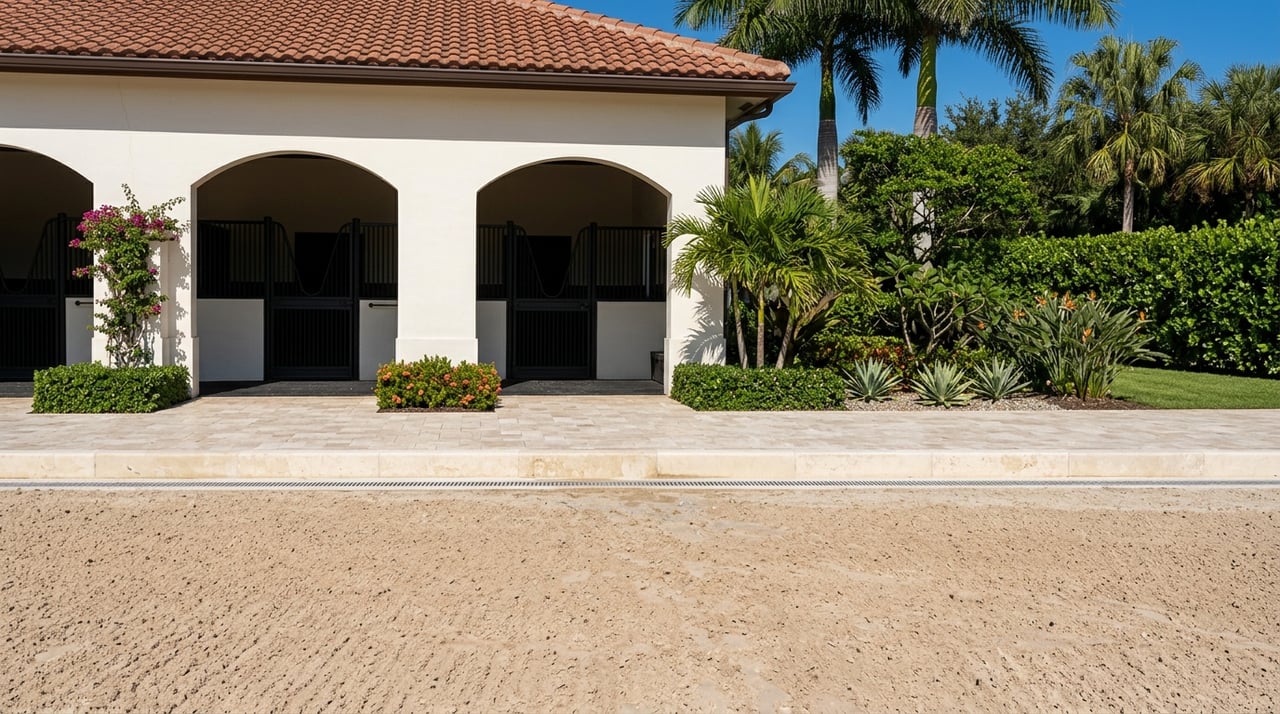
A Wellington farm often rises or falls on arena performance. For many buyers, the ring is not just an amenity. It is the working center of the property.
Ask for the footing specification, installation date, grooming schedule, and any recent reconditioning invoices. Arena surfaces wear out over time, and deteriorating footing can increase dust, reduce consistency, and lead to more frequent maintenance.
The research describes arena footing as a three-layer system made up of a top footing layer, a compacted base, and a sub-base that promotes drainage. Outdoor arenas may also need a crown with a 1% to 2% slope to move water off the surface.
The same guidance notes that top footing is often 2 to 6 inches thick and the base about 6 to 8 inches thick. Coarse, well-sorted sand is commonly used because it promotes drainage and helps reduce dust.
You do not need to become an engineer during due diligence, but you do want a clear history. If a seller cannot explain what was installed, when it was last refreshed, and how it has been maintained, that is a sign to investigate further.
For many Wellington buyers, location is about more than a neighborhood name. You are also buying into a transportation pattern that affects every schooling day, show day, and staff routine.
Wellington International’s main entrance is at 3400 Equestrian Club Drive, and Equestrian Village is at 13500 South Shore Blvd. The venue hosts the Winter Equestrian Festival, the Adequan Global Dressage Festival, and the Annual Series. The area also includes the National Polo Center, another major equestrian destination in Wellington.
Within the EPA, Wellington says the Village has maintained more than 100 miles of bridle trails. Trail footing, crossings, and trailheads are part of its capital planning, which makes trail access a meaningful lifestyle and logistics factor for some buyers.
Before closing, test the route from the farm to the venues you use most. Proximity on a map does not always reflect how practical the trip feels with a trailer, service vehicle, or daily support traffic.
You should also confirm road access and frontage. The research indicates that access to paved roads can matter for some equestrian uses, so this is worth checking during touring and contract due diligence.
A strong equestrian purchase file should include more than the standard residential paperwork. Ask for these items early so you have time to review them properly:
Some buyers assume an agricultural classification will automatically improve the financial picture. Palm Beach County’s Property Appraiser makes clear that the parcel must be used for a bona fide commercial agricultural purpose, and applications must be filed by the owner of record between January 1 and March 1.
The Property Appraiser also states that agricultural classification is not intended simply to avoid permitting. Just as important, it warns that the classification does not always save taxes and that losing it can create a significant increase because the land returns to market value.
If agricultural treatment matters to your purchase decision, verify the current status and ask what would be required after closing. A new owner should not assume the classification will continue automatically.
Wellington equestrian purchases involve overlapping layers of review. You may be looking at Village zoning, County use standards, floodplain designations, water-management permitting, and district assessments on the same property.
That complexity is exactly why experienced local guidance matters. When your advisor understands barns, footing, access routes, and local approval frameworks, you are better positioned to identify the right property and avoid expensive surprises.
If you are considering a Wellington equestrian farm, Martha W. Jolicoeur PA can help you evaluate opportunities with the local knowledge, equestrian fluency, and discreet guidance these purchases demand.
Stay up to date on the latest real estate trends.


Whether working with buyers or sellers, Martha provides outstanding professionalism into making her client’s real estate dreams a reality. Contact her today for a free consultation for buying, selling, renting, or investing in Florida.
Get in Touch With Martha Team to Learn More

MARTHA W. JOLICOEUR PA
✉ EMAIL:
✆ TELEPHONE NUMBER:
⚲ ADDRESS: 13501 SOUTH SHORE BLVD STE 102 WELLINGTON FL 33414